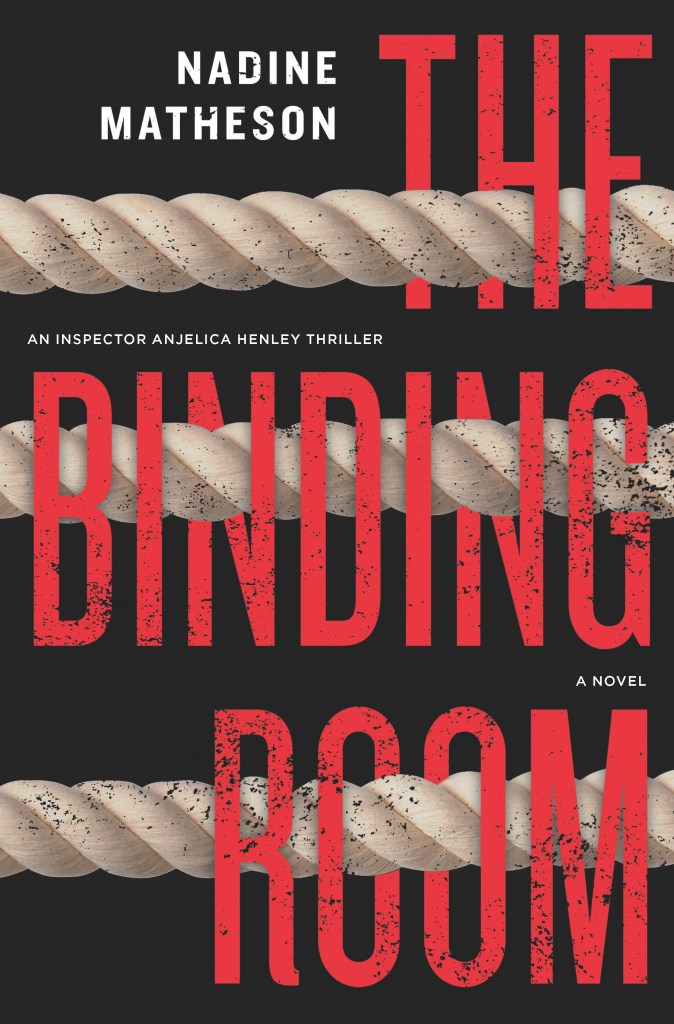
Blog Tour | The Binding Room by Nadine Matheson | Excerpt

Detective Anjelica Henley confronts a series of ritualistic murders in this heart-pounding thriller about race, power and the corrupt institutions that threaten us for fans of S.A. Crosby and Tami Hoag

When Detective Anjelica Henley is called to investigate the murder of popular preacher in his own church, she discovers a second victim, tortured and tied to a bed in an upstairs room. He is alive, but barely, and his body show signs of a dark religious ritual.

With a revolving list of suspects and the media spotlight firmly on her, Henley is left with more questions than answers as she attempts to untangle both crimes. But when another body appears, the case takes on a new urgency. Unless she can apprehend the killer, the next victim may just be Henley herself.

Drawing on her experiences as a criminal attorney, Nadine Matheson’s new novel deftly explores issues of race, class and justice through an action-packed story that will hold you captive until the last terrifying page.

Buy Links | Bookshop.org | Harlequin  | Barnes & Noble | Amazon | Books-A-Million | Powell’s

“We all lost,” said DS Paul Stanford as he held out a Quality Street tin in front of Henley.

“What on earth are you talking about?” Henley asked as she took off her coat and flung it onto a spare desk. “Are there any toffee pennies in there?”

“You might want to keep your coat on. The heating’s on the blink again. Either that or they’ve forgotten all about us and haven’t paid the bill. There’s a hundred and forty pounds in the pot and no toffee pennies.”

“Why is there a hundred and forty quid in there?”

Stanford rolled his eyes in mock exasperation. “Remember our bet?” he said. “On him. Our illustrious fully fledged Detective Constable Ramouter.”

“What have I done?” Ramouter asked from his position in the kitchen where he’d been eyeing the bottom of a mug with disgust.

“This is ridiculous,” Henley said. Her ears picked up the whirr coming from the electric fan heaters and the ice-fueled wind whistling outside and rattling the glass.

“You lasted, Ramouter; that’s what you did,” said Stanford. “We had a bet on how long you would last in the SCU.”

“And you didn’t think that I would last six months?” asked Ramouter as he picked up another mug.

“Mate, I didn’t think you would last six days. I’ll have a coffee if you’re making.”

“You shouldn’t be so mean to him,” said Henley as she took off her scarf and pushed it against the rotting frame of the window to block the icy draft that was sweeping across her desk.

“How am I being mean? I’m paying him a bloody compliment. After everything that happened, no one would have blamed him if he’d bolted for the door.”

“Well, he didn’t. He’s stuck with it. So, what are you going to do with the money?”

“I could give Ramouter the money. He could spend it on a train ticket to Bradford or something.”

“Now who’s getting soft?” Henley said. The phone on her desk started to ring.

“Or I could book a table at the curry house down the road. It will be teambuilding.”

“Or a normal Friday night out with you falling asleep in your chili chicken.”

“Rude,” Stanford replied as Henley picked up the phone and Ramouter appeared by his side with a mug of steaming coffee for him.

“Right. I see,” said Henley, reaching for the pad of blue Post-it notes on her desk and a ballpoint pen with a chewed cap. “I didn’t realize that we were still on duty. Can you send me the CAD details? No, I can’t get it myself because the system has crashed again. Thank you. Who found the body? Right.”

Henley pulled off the Post-it note and stuck it to the side of Ramouter’s mug. He peeled it off and looked at it quizzically. “Depending on traffic, we should be there in fifteen minutes.”

“You’re not going to have time to finish that,” said Henley, putting the phone down and grabbing her scarf.

“There’s a body in a church?” Ramouter said as he read the note. “Seriously?”

“That’s what it says.”

“Why are we dealing with this?”

“We’re dealing with it because the borough commander decided that the Serial Crime Unit should be helping out Homicide and Serious Crime with their caseload,” Henley replied wearily.

“Anyone would think that we were just sitting here watching Netflix all day,” Ramouter moaned. “Is it even a murder?”

“We won’t know until we get there, will we?”

“Can I say it?” asked Stanford, a grin spreading across his face.

“No, you can’t,” Henley replied. She picked up her bag and headed toward the door, with Ramouter in tow. She knew Stanford well enough to know exactly what he was going to say.

“I bet you a tenner that it was the Reverend Green with a candlestick in the library,” Stanford shouted out as Henley slammed the door shut behind her.

“I’m not telling you again. Step away from the tape.”

“What’s going on?”

“If I knew I was going to spend the afternoon standing out in the freezing cold I would have stayed in bed this morning.”

“I bet that they’ve found a body or something.”

“Look, those CSI lot have turned up.”

“I only popped out for a coffee and now the old bill are saying that I can’t go back into my own office.”

“F this. I’m going home.”

“I’m telling you that they’ve found a body.”

“Wouldn’t be the first time.”

“I don’t understand these kids. Too busy stabbing each other up. No value for life.”

“You can dress it up as much as you like. It’s Deptford innit.”

The murmurings of the curious and disgruntled crowd met Henley and Ramouter as they walked toward the scene of the crime.

“This is a church?” Ramouter asked as he looked up at the cream-colored facade of the brickwork. “I was expecting something a bit more… I don’t know, church-like. Maybe a steeple. This looks like a bank.”

“It used to be a NatWest when I was seventeen. The space was once cheap to rent. Not so sure now,” Henley replied.

“I did a quick Google search—”

“Of course you did.”

“And there’s another seven churches on the Broadway.”

“I’m not surprised,” said Henley. “Betting shops, churches and chicken shops on literally every London high street.”

Henley and Ramouter held up their warrant cards to the officer behind the police tape. Henley scoped the gathering crowd. Nothing about them raised any alarms, but she knew from experience that some murderers were voyeuristic by nature.

“Look likes Dr. Choi is here,” Ramouter said, pointing out the car of Henley’s friend and the Serial Crime Unit’s favorite pathologist, parked between a police motorbike and small white transit van that had ‘Forensic Services Crime Scene Investigation’ marked in black font on the side.

Henley stopped and looked around the small car park. There were no security cameras. She felt a sense of calm as she walked closer to the crime scene. It was a welcome emotion and a respite from the anxiety that was usually coursing through her veins, which she could keep at bay if she bothered to take her prescription to the chemist. She spotted the police officer that she was looking for leaning against the side of a police car, flipping through the pages of his notebook with a pen in his mouth.

“PC Tanaka? DI Henley from the SCU.”

PC Tanaka looked up and then stood to attention a little bit too quickly as Henley walked toward him.

“Ma’am,” said PC Tanaka.

“This is my colleague, DC Ramouter.”

“Shit,” said PC Tanaka when he dropped his notebook. “Sorry.” He brushed off slush from the cover. “It’s bloody freezing.”

“You were first on scene?” Henley asked.

Tanaka nodded. Henley could tell that he wanted to get it right. Giving a senior officer information about a murder scene was a lot different to dealing with burglaries, domestics and breaking up a fight between a couple of crackheads at the bottom of the high street.

“We, that’s the sarge, Sergeant Rivers, and I were driving back to the station. We’re based around the corner at Deptford station. We had just finished our shifts and was coming back from the McDonald’s up the road…”

PC Tanaka paused and took a breath.

Henley felt sorry for him as nerves or possibly shock overtook him. She saw a look of sympathy on Ramouter’s face as they both waited for PC Tanaka to continue.

“Sorry, guv, I mean ma’am,” said PC Tanaka straightening himself again and lowering the volume on his crackling police radio. “As I said, we were heading back to the station and one of the guys who works in the design agency practically threw himself onto the bonnet of the car. He was screaming about a body. We found the cleaner in hysterics in the staffroom of the agency. She refused to leave and take us to the church. I left her with the sarge and I went into the church and yeah, I won’t forget what I saw.”

Nadine Matheson is a criminal defense attorney and winner of the City University Crime Writing competition. She lives in London, UK.

Social Links | Author Website | Twitter: @NadineMatheson | Facebook: @NadineMathesonWriter | Instagram: @QueenNads | Goodreads

Happy reading!

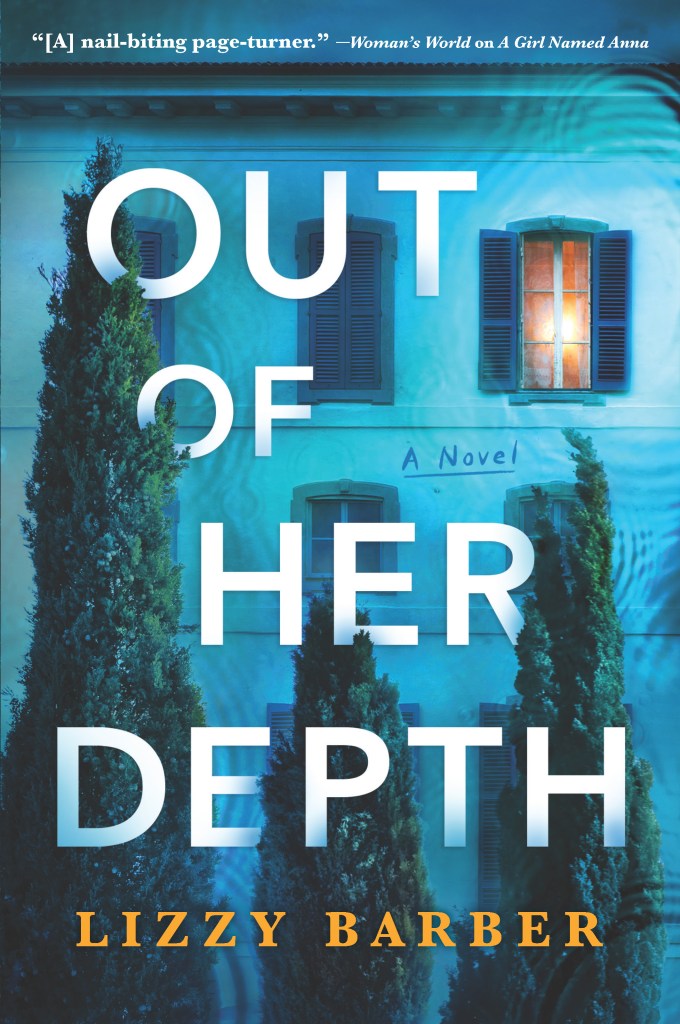
Blog Tour | Out of Her Depth by Lizzy Barber | Excerpt

Rachel lands her dream summer job at a luxurious Tuscan villa. She’s quickly drawn into a new group of rich and beautiful sophisticates and their world of partying, toxic relationships, and even more toxic substances. They’ve never faced consequences, are used to getting everything. But then someone goes too far. Someone dies. And nothing will ever be the same.

Lizzy Barber’s debut A Girl Named Anna won the Daily Mail First Novel Competition. In her newest and even more unputdownable work, she weaves a clever and deadly web of manipulation and desire. A summer thriller rife with back-stabbing, bed-hopping, and murder, Out of Her Depth is a perfect escapist read for fans of Euphoria, J.T. Ellison’s Her Dark Lies, or Rachel Hawkins’s Reckless Girls.

Buy Links | BookShop.org | Harlequin | Barnes & Noble | Amazon | Books-A-Million | Powell’s

Before you judge me, remember this: a girl died, but it wasn’t my fault.

I know that seems like a pathetic confessional. Even more pathetic because the confession itself has, until this point, never been uttered.

I’ve wanted to. Believe me, I’ve wanted to.

The words have formed themselves on the precipice of my tongue, palpitating with their ugly need to be heard, to make me part of the narrative. To declare to the A-level students when I see it coming up on their news feeds, languorously debating it, now, once more, as it has risen into public consciousness twenty-one years after the fact: I was there.

When they stumble in late to my lesson, less eager to talk of the trapassato prossimo than about who fucked whom at last night’s social, and whether crimped hair really is making a comeback.

I was there.

When they blink at me from faces still etched with yesterday’s makeup, reeking of the top-shelf vodka and menthol cigarettes that their house mistresses will studiously ignore.

I was there.

When they declare they “really struggled with this week’s essay” so they only have notes, and they say, “About that C on the mock exam… Did you know my parents funded the library?” and they don’t even bother to wait for the response as they pull out their laptops and glance at their watches, and they think to themselves, Boring bitch has never lived.

I was there.

I imagine each letter incubating in the saliva that pools in the side of my gums. I picture myself standing, drawing the blinds. An illicit eyebrow raise that will make them pause, look up at me anew, place their laptops on the floor as I edge toward them.

Screw Dante. Let me tell you a real story about Florence.

..….

Now

I am just leaving for dinner when I hear.

People talk of remembering exactly where they were when great events happened: Princess Di, the Twin Towers, Trump. I know this isn’t quite on the same scale, but I’ll remember exactly where I was, all the same.

I’ve had back-to-back lessons all day, but now, at last, I have an hour to myself, the only person left in the languages office. I spend it working on my paper “Pirandello and the Search for Truth” for the Modern Language Review, barely coming up for air. This is the part of academia I enjoy the most: the research, the pulling together of an idea, the rearranging of words and thoughts on the page until they start to take on a life of their own, form arguments, cohesion. I’m hoping that this will be the one they’ll finally agree to publish.

I am the only French and Italian teacher at Graybridge Hall, 

have been for the last ten years. When they decided to introduce Italian for the younger years, as well as the older students, I did suggest that perhaps now it would be time to look at hiring someone else. But Ms. Graybridge, the eponymous head—and third of that name to have held the position—reminded me that the school’s ethos was “personal and continuous care for every girl.” Which didn’t really make sense as a rebuttal, but which I knew was shorthand for no, and which she knew—because of certain circumstances under which I assumed my position in the first place—I wouldn’t argue with.

Not that I don’t enjoy teaching. Sometimes. “shaping young minds” and all that seems like it should be a worthy cause. When I was younger, much younger, I imagined maybe I would do a PhD, become a professor. I also thought about diplomatic service, traveling the world as a translator, journalism, maybe, why not? Instead I sit through mock orals on topics as ground-breaking as Food and Eating Out, Cinema and TV, and My Family.

My rumbling stomach is the first signal I have that evening is approaching, and when I tear myself away from my laptop screen to look at the darkening sky, I decide to ditch my planned root around in the fridge, and be sociable instead. Wednesday is quiz night at the pub near school. A group of teachers go every week, the little thrill they get as their cerebral cortexes light up with a correct answer just about making up for a day spent asking the girls to kindly not look at their Apple Watches until break, and maybe not take their makeup out of their Marc Jacobs backpacks until class is over just this once.

I close down my laptop and do a brisk tidy of the room before slipping on my coat and scarf, and am just about to slide my phone into my rucksack when an alert catches my eye—specifically, a name, bouncing out of the BBC News push notification, one I have avoided all thought of for a long while, as much out of circumstance as necessity.

Sebastian Hale.

I freeze in the doorway—phone clutched in my hand as preciously as though it were the Rosetta stone—and look again, not quite believing I saw it right, presuming perhaps it was just wishful thinking, a long hour of screen-staring playing tricks on my eyes, that could have conjured his name before me.

But there it is. That name. Those five syllables. The six vowels and seven consonants that have held more significance for me than any word or sentence written in my entire attempted academic career.

And next to them, three words that throw my whole world off kilter, that see me reaching for the door handle and wrenching it shut, all thoughts of dinner gone from my mind:

Sebastian Hale Appeal Proceeds Tonight.

I sit at my desk, lights off, face illuminated by the white glow of my phone screen, and read someone else’s report of the story I know so well. The story I have lived. I place the phone facedown on the desk, snuffing out its light, and press my palms into the woodwork. The feel of my flesh rubbing against the desk’s smooth surface grounds me, helps me process the report—think.

I knew there had been requests for appeals over the years, all denied by the Corte d’Assise d’Appello. A change of lawyer, probably hoping that new eyes on the case could find something that was missed. But they’ve all come to nothing. How did I miss this?

If he is retried, if there is any possibility that he might be released…everything would change.

After the initial trial, after my part was done and I could finally go home and resume the life I had worked so hard to live. I tried—I really, truly tried—to put it behind me.

That was what she did, after all, and I wanted to follow her lead. I have always wanted to follow her lead. But that time has never truly left me. Sometimes, it will take the smallest thing—the light filtering through a window just so, a particular kind of humid heat, walking past a patisserie and being hit with a waft of baked vanilla sweetness—and it all comes back to me with cut-glass clarity. The sound of our laughter ricocheting off ocher-colored walls. The clink of glasses and the taste of hot weather, raw red wine. The touch of sweat-dewed skin. The scent of pine. The giddy, delightful feeling of being young and happy and having the rest of our lives spooling out in front of us.

These are the good things—the things I want to remember.

The bad things…those I have no choice but to remember.

And now, at the sight of his name alone, I am instantly transported: flying on the wings of a deep déjà vu, away from the cold late-autumn day and the dusty corners of my tired office and back, back, back to that time—that summer.

To those gold-tinged days and months that crescendoed so spectacularly into those final, onyx hours.

To the start.

Lizzy Barber studied English at Cambridge University. Having previously dabbled in acting and film development, she has spent the last ten years as head of marketing for a restaurant group. Her first novel, A Girl Named Anna, won the Daily Mail and Random House First Novel Prize. She lives in London with her family.

Social Links | Author Website | Twitter: @ByLizzyBarber | Facebook: @ByLizzyBarber |
Instagram: @ByLizzyBarber | Goodreads

Happy reading!

Blog Tour | A Proposal They Can’t Refuse by Natalie Caña | Excerpt

“My Big Fat Greek Wedding” but make it Latinx when a Puerto Rican chef and an Irish American whiskey distiller are blackmailed into a fake relationship by their scheming octogenarian grandfathers.

Ain’t nobody got time for octogenarian blackmail, especially Kamilah Vega. Convincing her parents to update the family’s Puerto Rican restaurant and enter it into The Fall Foodie Tour is quite enough on her plate, muchas gracias. And with the gentrification of their Chicago neighborhood, the tour looks like the only way to save the place. Too bad her abuelo made himself very clear; if she wants to change anything in his restaurant, she must marry the one man she can’t stand: his best friend’s grandson.

Liam Kane spent a decade working his ass off to turn his family’s distillery into a contender. Now he and his grandfather are on the verge of winning a national competition. Then Granda hits him with a one-two punch: he has cancer and has his heart set on seeing Liam married before it’s too late. And his Granda knows just the girl… yup, you guessed it, Kamilah Vega.

If they refuse, their grandfathers will sell the building that houses their businesses, ruining all their well-laid plans. With their legacies and futures on the line, Kamilah and Liam plan to outfox the devious duo, faking an engagement until they both get what they want. But the more time they spend together, the more they realize how much there is to love. Soon, they find themselves tangled up in more than either of them bargained for.

BUY LINKS | Bookshop.org | Barnes & Noble | Amazon

Kamilah Vega stomped up the short entryway and yanked the heavy glass door open with more force than necessary. A strong wind, the type only ever experienced in Chicago, grabbed a hold of the door and pushed it back so roughly that it made a loud bang. The front-desk secretary jumped and gave her a dirty look, but Kamilah barely noticed. Her attention went immediately to the two bodies slumped in the love seat outside the director’s office. 

She tried her best to keep the anger out of her voice because she already knew how the two troublemakers in front of her would react to it. “What did you do now?” 

That garnered an immediate and very predictable response of “Nothing” from both occupants. It was a lie, of course. It always was whenever these two started claiming innocence in unison. 

Kamilah rubbed both hands over her face and let out the type of deep and weary sigh that someone should let out at midnight after a hard and long day—not at eight thirty in the morning. She dropped her hands. “Don’t you think it’s time to stop with the shenanigans? You’re eighty years old, Abuelo.”

Her grandfather gasped in outrage at the mention of his age and scowled at her. His salt-and-pepper hair was sticking up all over the place like a fuzzy baby monkey, making him look adorable despite the baleful glare.

Looking decidedly more put together, even in his tattered denim overalls and faded flannel, Abuelo’s roommate and best friend gave her his own version of the stink eye. “You’re only as old as you feel,” Killian replied in his deep Irish brogue.

“And that means what? That you two feel twelve?”

Before they could answer, the door to the office opened, and there stood Maria Lopez-Hermann, the director of Casa del Sol Senior Living. “Hello, Kamilah. I’m glad you were able to come on such short notice. I know you were probably in the middle of morning prep at the restaurant.”

Kamilah didn’t bother telling Maria that after closing the night before, she’d slept through her many alarms and was late to work. Now, thanks to the two hooligans next to her, she was going to be very, very late. Her employers wouldn’t care about her excuses. It didn’t matter that they were her parents. Kamilah was a Vega and an employee, so her main responsibility was to the family restaurant. Always.

Maria motioned for them to enter her office, and they filed in. Kamilah purposely let Abuelo and Killian sit in the two chairs in front of Maria’s desk, while she stood behind them, a hand on each of their shoulders. It was the same stance her mami had taken the time she and her cousin Lucy had got in trouble for skipping gym class for two weeks.

Abuelo crossed one leg over the other and tucked his hands under his armpits, while Killian leaned back, spread his legs wide, and let his arms hang over the short back of the barrel chair. Kamilah once again marveled at their ability to look summarily unconcerned while she was sweating bullets, and she hadn’t even done anything.

Maria took a seat behind her desk and interlocked her fingers, resting them on top of her desktop calendar. “I thought I had made myself clear after the bird incident that being banned from pet therapy would be the least of your worries if there were any more pranks pulled.”

Kamilah closed her eyes and shook her head. It was a variation on what she’d said right before giving the Devious Duo a monthlong suspension from bingo for starting an illicit gambling ring; before that, there was a security-enforced curfew after the strip-poker fiasco. “What did they do now?” she asked, well aware that it was the third or fourth time she’d asked the question that morning and had yet to get a response.

“This morning we had two residents with high blood pressure show alarmingly high readings after breakfast. We did some investigating and found that Mr. Kane and Mr. Vega had snuck into the cafeteria last night and replaced the decaffeinated coffee grounds with fully caffeinated espresso.”

“Abuelo!” Kamilah exclaimed.

“They don’t have any proof it was us,” Killian interjected. “They just want to blame us for everything that happens in this godforsaken prison.”

“Prison,” Kamilah scoffed. “You two have more freedom than anyone else in here.” It was true. Because of their relatively good physical health and stable mental health, Abuelo and Killian didn’t require as much care as many of the other residents. It was more as if Casa del Sol were their college dorm rather than their senior-care facility. It didn’t help that the two tended to view the senior-living center’s strict rules as friendly suggestions.

“Your feelings aside,” Maria continued, “we do have proof. The cameras that we installed in the cafeteria and kitchen caught very clear images of you both.”

Abuelo softly damned the cameras. “Condenados cámaras.”

But Killian had other concerns. “You hear that, Papo? Freedom,” he harrumphed.

“They won’t even let me drink café con leche,” Abuelo added. “They give me light brown poop water and call it coffee.”

“It’s decaf with a splash of coconut milk, and your doctor says it’s better for your heart,” Kamilah pointed out. Abuelo’s doctor also said his congestive heart failure was very treatable as long as he took his meds, stuck to a heart-healthy diet, and remained relatively active. Of course, Abuelo paid him no attention.

As if on cue, Abuelo made a noise of disdain. “Ese doctor no sabe na’. Cuando me duele el pecho, me pongo un poco de Vaporú y ya.”

Kamilah sucked her teeth more at the claim that his doctor knew nothing than at the miraculous healing quality of Vicks VapoRub. All Latinx people knew Vaporú was the cure for everything from a common cold to heartbreak.

Abuelo looked at the director of the complex with petulance. “And when are you going to start serving carne frita con mofongo?” Abuelo continued, because apparently he was on a roll. “I’m sick of eating all these steamed vegetables like a damn rabbit.”

Maria leaned forward. “Mr. Vega, if you are so unhappy with Casa del Sol, you are welcome to find another living facility to reside in.”

Kamilah jumped in before her hardheaded grandfather could ruin the best thing he had going for him. “Maria, could I talk to these two alone for a few minutes before you lower the hammer?”

Used to their antics, Maria nodded her head and left the office.

Kamilah sank to her haunches between their chairs and waited until both men looked at her. “You guys have to stop this,” she said in her voice of reason tone. She placed a hand on each of theirs. “I don’t have time for you to be staging weekly high jinks like you’re the Little Rascals. I can’t be here all the time making sure that you don’t get kicked out.”

Abuelo turned his face away. “Nobody told you to come act like our mother.”

Killian nodded. “We are grown men.”

“Bullshite,” a deep voice sneered from too damn close, startling Kamilah right as she felt a presence looming over her.

A girl who grew up on the West Side of Chicago and with four tormenting older brothers knew to strike first and ask questions later.

“Not today,” Kamilah declared in her You-Messed-Withthe-Wrong-Bitch voice, spinning around in her crouched position, morphing into famous Chicago heavyweight champion Ernie Terrell, and swinging her fist at her would-be attacker’s crotch.

The moment her fist connected with the very sensitive part of the man’s anatomy and she heard his pained “Son of a bitch,” she knew she’d made a grave mistake.

Oh dear God, no. Not him. Please don’t let him be here.

Meanwhile, Tweedledum and Tweedledee laughed their asses off like a pair of demented hyenas.

When he fell to his knees, Kamilah suddenly found herself face-to-face with the exact man she’d just prayed wasn’t there.

Big, broad, and brooding, Killian’s grandson didn’t resemble him in the least. Where Killian had a round face and wide nose with a bit of a hook at the end, Liam looked like something conjured out of the tie me up and spank me books her sister-in-law was always reading. His face was all sharp angles, set off by dark stubble, a stern mouth, and cool eyes.

“What is wrong with you?” He wheezed. “You can’t just go around dick-punching people.”

The hyenas laughed harder.

Kamilah’s jaw dropped. “What’s wrong with me?” she asked, incredulous. “What’s wrong with you, coming up on me like that? You don’t sneak up on a woman and expect not to get junk-punched. Especially not a woman born and raised in Humboldt Park.”

His French-blue eyes narrowed under dark brows. His nostrils flared while he inhaled deeply. That was Liam speak for I’d really like to tell you off right now, but not going to engage.

Kamilah saw that look often. Whatever. He pissed her off too.

“She has a point, lad,” Killian said, the amusement still thick in his voice. “You deserved that whack to the wanker.” He stood and pulled his grandson to his feet.

Kamilah found herself once again eye level with Liam’s crotch. She quickly stood and turned away from him, her face flushing with embarrassment. She met Abuelo’s gaze.

He arched his brows. “Nena, aren’t you going to apologize to him?”

“Me? Apologize to him?” Kamilah let out an incredulous bark of laughter. “He should apologize for sneaking in here and scaring me.”

“He didn’t sneak. The door was open.”

Kamilah didn’t answer. She should own up to her part and apologize, but her pride wouldn’t let her. Pride was the only thing protecting her from Liam. She couldn’t let it go now.

Liam stared, expressionless. Then he ignored her comment completely. “Granda, what did you do now?”

Kamilah hated when he ignored her.

Killian opened his mouth, but Liam cut him off. “And don’t say nothing, because I know you better than that.”

Before Killian could come up with a story, Maria walked back into the office. “They threw away all of the decaf coffee and replaced it with Café Bustelo espresso.”

“What the hell, Granda? You are willing to get kicked out of this place over coffee? Seriously?”

“It’s not the coffee. It’s the principle,” Killian replied, his nose in the air.

Liam threw up his hands and let out a sound of exasperation. “What principle? That the people you pay to take care of you actually take care of you?”

Killian crossed his arms. “You don’t get it because you’re young.”

“I don’t get it because it’s nonsense. Granda, where do you plan to go if you get kicked out? You sold your house to move in here with Papo.”

At the mention of the house he once shared with the love of his life, Killian’s face fell. That had been his wife’s dream house, and Kamilah had always suspected that he hadn’t really been ready to sell it.

“If you get thrown out, you can’t live with me, Granda.”

That was too much. Kamilah certainly wasn’t in agreement with their troublemaking, but Liam didn’t have the right to speak to his grandfather that way. Not after all Killian had done for him. “Because God forbid Super Loner Liam has to allow someone into his hermit cave.”

He turned on her. “Excuse me?”

“I’m saying that if they did get asked to leave, which we don’t know is going to happen, it wouldn’t kill you to let your grandpa move in with you. That’s what family does.”

“I was referring to the fact that he can’t walk that many stairs anymore, but I guess, as the almost thirty-year-old woman living with her parents, I should take your word on that other stuff.”

Kamilah scowled. He didn’t have to bring up her living situation like that. “It’s interesting, isn’t it? It’s like it’s not a big deal for us, because I’m not a miserable person who is extremely difficult to be around.”

Liam scowled at her. “Don’t you have somewhere to be? Like, off making someone else’s day shitty?”

Rude. Her pulse sped up. “I usually would, but since I already started with you, I can check it off my to-do list and it’s not even ten o’clock. Thanks a bunch.” She added a sweet smile.

“Glad to be of service.”

“Would you two just get a room already?” Killian said. Liam turned his dark look on his grandfather, and she made a disgusted noise.

“What?” Killian shrugged. “All I’m saying is you two fight like a couple.”

“Yeah.” Abuelo added his two cents. “You should just get married already.”

There was a beat of silence, and then both octogenarians’ eyes lit with the same mischievousness. The kind that had no doubt led to all of them being in their current situation.

You know what? Let’s get back to the reason we are here.” She faced Maria. “They may not look it, but I know Abuelo and Killian are sorry for the danger they put their fellow residents in, and next time they will think more about the consequences before they do something so incredibly stupid.”

Maria let loose a world-weary sigh, much like the one Kamilah had released earlier. She gave a small eye roll while shaking her head because they both knew Kamilah was full of shit. “Their cafeteria privileges have been revoked for the next two weeks. Prepackaged paper-bag meals will be sent to their apartment, or their families will have to provide their meals for them.”

“Is that supposed to be a punishment?” Abuelo asked.

“With the stuff they serve here, it feels more like a rew—”

Kamilah covered his mouth with her hand. “That seems totally fair.” In her head she was freaking out because she just knew she was going to be the one providing said meals, and she did not have the time for all that. “I’ll make sure they get fed.” She felt Abuelo’s mouth curve behind her hand, and she saw Killian’s pleased smile. “Don’t get too happy,” she warned. “You think they denied you? Just wait to see what I have in store. When I’m done with you, you are going to wish you could eat rabbit food.”

They were completely unfazed by her threats. Probably because they knew Kamilah was a crème brûlée—right below a crackly hard surface, she was really just pudding.

Echoing her thoughts, Liam scoffed. “As if you aren’t going to end up making them three-course meals complete with dessert.”

Kamilah fought the urge to stick her tongue out at him like a six-year-old. Instead, she ignored him. “I have to go to work, but for the love of God, please behave yourselves today,” she begged the duo of deviants.

She was almost positive she heard Killian mumble, “We make no promises.”

Natalie Caña writes contemporary romances that allow her to incorporate her witty sense of humor and her love for her culture (Puertominican whoop whoop!) for heroines and heroes like her. A PROPOSAL THEY CAN’T REFUSE is her debut novel.

SOCIAL LINKS | Author website: http://nataliecana.com/services-and-pricing | Twitter: @NatCanaWrites | Tik Tok: @nataliecwrites

Happy reading!

Blog Tour | Christmas at the Chateau by Rochelle Alers

The halls are decked for holiday romance in nationally bestselling author Rochelle Alers’s latest book in the Bainbridge House series! Christmas dinner’s on the table, and it’s being served with a side of romance! Executive chef Viola Williamson has to have the kitchen up and running by the time the Bainbridge House restoration is complete. Working closely with Dom Shaw, Viola is struck by her hotter-than-mulled-cider attraction to her family estate’s handsome caretaker. It’s obvious that he feels it, too—yet Dom keeps his distance. Can Viola convince him that with all this cooking going on, he’s the only one stirring her heart? 

Buy Links | Amazon | Barnes & NobleHarlequin

I’m excited to show you guys an excerpt for this book today, enjoy!

Dom turned his head, successfully hiding the smile struggling to emerge. He didn’t know why, but he hadn’t expected to overhear the ribald curse that had flowed so effortlessly from Viola. “That’s good to know because that would definitely negate us becoming friends.”

Viola narrowed her eyes, reminding him of a cat ready to attack. “Do you always test your friends?”

“Most times I do.”

“Why, Dom?”

“Because I have trust issues.” The admission had come out unbidden. But if he were completely forthcoming with Viola, then he would’ve said his distrust was with women. It didn’t matter whether they were platonic or intimate, he’d made it a practice to keep their relationships at a distance.

“Bad breakup with a girlfriend?”

“No,” he said truthfully. “It was a marriage that ended with irreconcilable differences.”

She blinked slowly. “Well, you’re not the only one with trust issues. And mine are not with an ex-husband but with the men I’ve dated. They say one thing and do something entirely different.”

This time Dom did smile. She’d just given him the opening he’d needed to discover more about her. “Are you saying you’re not currently involved with anyone?”

“That’s exactly what I’m saying. I’m not involved and don’t want to become involved. Right now, my sole focus is getting these kitchens renovated so that I can be ready once the hotel opens for business.”

It appeared as if they were on the same page when it came to relationships. Neither wanted one. And for him, it would make her presence on the property a win-win. Although he’d found Viola attractive, just knowing she didn’t want anything more than friendship would make it easy for Dom to relate to her as a friend.

“Do you have an idea as to what you want to offer your guests?” he asked, deftly changing the topic of conversation.

“That all depends on the clientele. If it’s a wedding, then that would be at the discretion of the bride and groom. However, for guests coming for a business conference, the food would be different from what would be served at a wedding reception. Then there are folks that may just want to stop by to hang out at the lounge for drinks and to watch sports. For them, I would have a special bar menu.”

“It sounds as if you have everything planned out in advance.”

Viola flashed a dreamy smile. “I would have to. I can’t afford to wait until we’re ready to open for business to begin creating menus without taste testing every item beforehand.”

Dom grinned from ear to ear. “I wouldn’t mind becoming one of your taste testers.”

She laughed. “I’ll definitely keep that in mind.”

Dom sobered. “When do you intend to come back here again?”

Viola also sobered. “Why?”

Hailed by readers and booksellers alike as one of today’s most popular African-American authors of women’s fiction, Ms. Alers is a regular on bestsellers list, and has been a recipient of numerous awards, including the Vivian Stephens Award for Excellence in Romance Writing and a Zora Neale Hurston Literary Award.  Visit her Web site www.rochellealers.com

Happy reading!

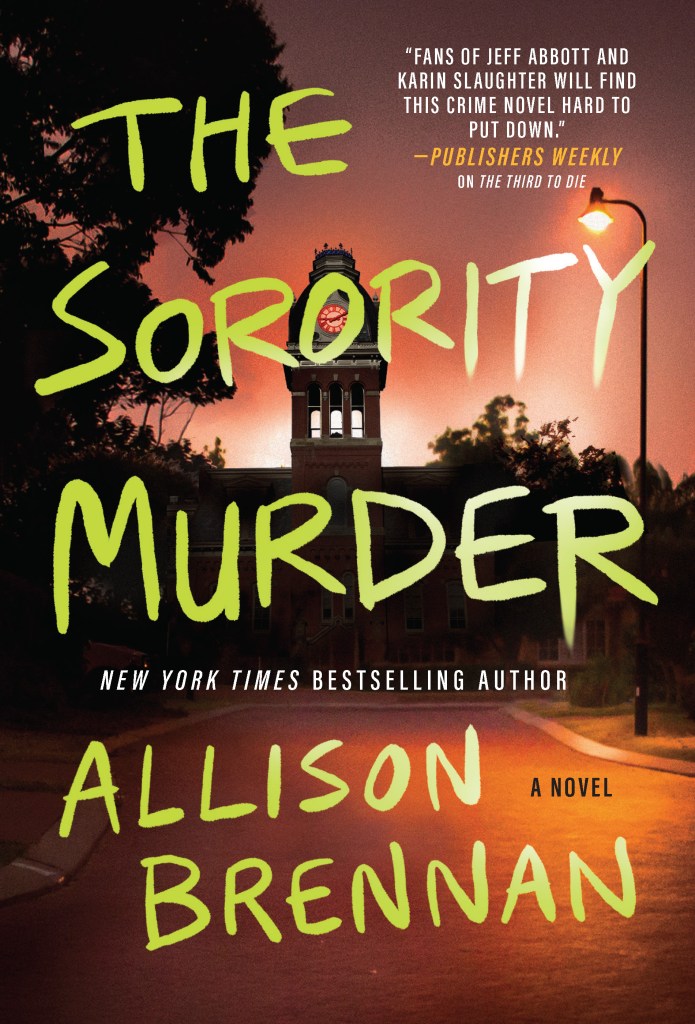
Blog Tour | The Sorority Murder by Allison Brennan | Excerpt

New York Times bestselling author Allison Brennan’s suspenseful new mass market original about a college senior’s podcast that delves into an unsolved campus murder of a sorority girl three years earlier, as individual callers explode every fact previously thought to be true.

Lucas Vega is obsessed with the death of Candace Swain, who left a sorority party one night and never came back. Her body was found two weeks later, and the case has grown cold. Three years later while interning at the Medical Examiner’s, Lucas discovers new information, but the police are not interested.

Lucas knows he has several credible pieces of the puzzle, he just isn’t sure how they fit together. So he creates a podcast to revisit Candace’s last hours. He asks listeners to crowdsource what they remember and invites guest lecturer, former US Marshal Regan Merritt, to come on and share her expertise.

New tips come in that convince Lucas and Regan they are onto something. Then shockingly one of the podcast callers turns up dead. Another hints at Candace’s secret life…a much darker picture than Lucas imagined—and one that implicates other sorority sisters. Regan uses her own resources to bolster their theory and learns that Lucas is hiding his own dark secret. The pressure is to solve the murder, but first Lucas must come clean about his real motives in pursuing this podcast – before the killer silences him forever.

Buy Links | Bookshop.org | Indie Bound | Barnes & Noble | Amazon |
Books A Million | Kindle | Nook | Kobo | Google PlayApple books

I’m thrilled to be able to include an excerpt in today’s post from this book. Enjoy!

One

Three Years Ago

Friday, April 10

 Candace Swain forced a smile as she walked out of her dorm room.

Smiling was the last thing she wanted to do, but Candace had an image to uphold.

She was going to be late for the Sigma Rho Spring Fling—the last big party before the end-of-year crunch. Studying for finals, capstones and senior projects, stress and more stress, and—for some of them—graduation.

The mild April weather was perfect for an outdoor gathering. Candace had led the sorority’s social-events committee with setup, and they’d included heat lamps along the perimeter. The Mountain View dorm—which housed all campus sororities, each with their own wing—was on the northeast corner of campus, adjacent to the football field. The Spring Fling was held on the large lawn that framed the north entrance, where they had the most room. It was open to all students for a five-dollar admission, and was one of the biggest moneymakers for the sorority, more than charities. Candace had fought for—and won—giving the profits to a rescue mission that helped people get back on their feet. She volunteered weekly for Sunrise Center, and it had changed how she viewed herself and her future. She now planned to be a nurse in the inner city, working for a clinic or public hospital, where people deserved quality health care, even if they were struggling. She even considered specializing in drug and alcohol issues, which were unfortunately prevalent among the homeless community.

She used to think of her volunteerism as penance for her failings. She wasn’t religious but had had enough preaching from her devout grandmother to have absorbed things like guilt, penance, sacrifice. Now, she looked forward to Tuesdays when she gave six hours of her time to those who were far worse off than she. It reminded her to be grateful for what she had, that things could be worse.

Candace exited through the north doors and stood at the top of the short flight of stairs that led to the main lawn. Though still early in the evening, the party was already hopping. Music played from all corners of the yard, the din of voices and laughter mingling with a popular song. In the dusk, the towering mountains to the north were etched in fading light. She breathed deeply. She loved everything about Flagstaff. The green mountains filled with pine and juniper. The crisp, fresh air. The sense of community and belonging felt so natural here, something she’d never had growing up in Colorado Springs. With graduation on the horizon, she had been feeling a sense of loss, knowing she was going to miss this special place.

She wasn’t close to her parents, who divorced right before she started high school and still fought as much as they did when they were married. She desperately missed her younger sister, Chrissy, a freshman at the University of South Carolina. She’d wanted Chrissy to come here for college, but Chrissy was a champion swimmer and had received a full scholarship to study practically a world away. Candace had no plans to return to Colorado Springs, but she didn’t know if she wanted to follow her sister to the East Coast or head down to Phoenix where they had some of the best job opportunities for what she wanted to do.

Vicky Ryan, a first year student who had aspirations of leadership, ran up to her.

“That weirdo is back,” Vicky said quietly. “Near the west steps. Just loitering there, freaking people out. Should I call campus police?”

Candace frowned. The man Vicky was referring to was Joseph, and he wasn’t really a weirdo. He was an alcoholic, and mostly homeless, who sometimes wandered onto campus and wouldn’t accept the help he had been repeatedly offered. He wasn’t violent, just confused, and sometimes got lost in his own head, largely from how alcohol had messed with his mind and body. But his problems understandably made her sorority sisters uncomfortable. He’d twice been caught urinating against the wall outside their dorm; both times, he’d been cited by campus police. He wasn’t supposed to be on campus at all anymore, and Candace knew they’d arrest him if he was caught.

“I’ll take care of it,” Candace said and made her way around the edge of the party.

She found Joseph on the narrow grassy knoll that separated the football field from the dorms. A small group of students approached her, but one in their group turned toward the grass, likely to confront Joseph.

Candace walked faster, caught up with the student, and smiled brightly. “I got this.”

“It’s okay,” he said. “I’ll handle him.”

“I said I will take care of this. I know him. But thank you anyway.”

Mr. Macho didn’t want to walk away, yet Candace stood firm. She didn’t want anyone to harass Joseph, and she knew he would listen to her. While he wasn’t violent, he could be belligerent, and being confronted by a jerk wanting to impress his girlfriend was a surefire way to trigger Joseph and have him dig in his heels. It would only lead to an arrest, and that wasn’t going to help him in the long run.

The group walked off, grumbling; Candace ignored them. She approached Joseph cautiously, so as not to startle him. “Joseph, it’s Candace,” she said. “Remember me? From Sunrise Center?”

He turned slowly at the sound of her voice. A tall man, nearly six foot four, he could intimidate people. But he was also skinny and hunched over from years of walking the streets and looking down, rummaging through garbage, with his hangdog face, ragged salt-and-pepper beard, and watery blue eyes. He was the kind of guy her grandmother would have called a bum—dressed in multiple layers of dirty, mismatched clothes, and smelling of dirt and stale beer. He looked about sixty, but she knew that he was only in his early forties. She’d heard he’d been living along Route 66 for the better part of ten years. The people who ran Sunrise Center didn’t know much about his personal life, only that when he was sober (which was rare), he would talk about home being east, at the “end of the line.” But no one knew if that meant Chicago or any of the stops in between.

Candace wanted to know more about his story, how he came to be in these circumstances, why he wouldn’t—or couldn’t—accept help. Many of the homeless who came to Sunrise for shelter or food would talk to her freely. But not Joseph. When she’d pried once, he disappeared for a while, so she stopped asking. She would rather him be safe than riding the rails, which was dangerous.

“Candace,” he said slowly after several moments.

“You can’t be here, Joseph. The campus police told you that. Don’t you remember?”

He didn’t say anything or acknowledge that he understood what she said.

“Would you like me to take you over to Sunrise Center? You can get a hot meal there, maybe a cot for the night.”

Again, silence. He turned away from her but didn’t leave.

She really didn’t want to call campus police, but if she didn’t do something, someone else would.

“Is there a reason you are here?” she asked.

“Leave me alone,” he said.

“I will, but you have to leave. Otherwise someone is going to call the police.” If they haven’t already.

He abruptly turned toward her, staggered on the slope of the lawn. His sudden movement startled her; she stepped back.

“No cops!” he shouted.

“You have to leave, Joseph,” she said, emphatic. Her heart pounded in her chest, not so much from fear but uncertainty. “Please go.”

Again, he turned abruptly, this time staggering down the short slope toward the stadium fence. She held her breath, watching him. He almost ran into the fence, put his arms out to stop himself, then just stood there. A minute later, he shuffled along the field perimeter, shoulders hunched, without looking back.

She breathed easier, relieved that he was heading off campus. She would talk to the director of Sunrise on Tuesday, when she went in to volunteer. Joseph couldn’t keep coming here, but she didn’t really want to call the authorities on him. He needed help, not more trouble, and definitely not incarceration.

Candace was about to return to the party when she heard someone call her name. She turned and saw one of her former tutoring students, Lucas Vega, running toward her. She didn’t want to talk to Lucas tonight. How many times did she have to tell him to leave her alone?

She stopped anyway and waited.

“Candace,” he said, catching his breath. “Thanks.”

“What do you want?” she snapped, crossing her arms over her chest.

“I’m sorry.”

“Sorry,” she said bluntly.

“I didn’t mean to upset you the other day. I am sorry about that.”

She blinked. He sounded so sincere. And truth be told, something he’d said to her a few days earlier made her think long and hard about herself, her life, and the time she’d spent as a student at Northern Arizona University.

A lie for a good reason is still a lie.

Lucas and his wide-eyed, good-natured innocence, his innocuous questions had her feeling guilty for no reason. He had picked up on that. And pushed.

No reason? Ha. Plenty of reasons. All these doubts and worries she’d been having this semester, the sleepless nights, all came from something she’d done as a freshman that she now had good reason to regret. But what could she do about it? What would come of the truth now?

Maybe there was no good reason to lie.

“All right,” she said. “Thank you.” It was easier to forgive Lucas than to hold on to this anger. None of what happened was Lucas’s fault.

“So will you tutor me again, for finals?”

“No. Afraid not.” She could forgive him for prying, but she really needed first to forgive herself. And she didn’t know if she could do that with Lucas around, reminding her of her failures and mistakes. He didn’t even know what she’d done, but seeing him now was like reliving the past, and her chest tightened. “I’m sorry, but I have too much studying of my own, too many tests. And I’m not working at the writing lab anymore.”

Because of you.

Was that even fair? Was it because of Lucas…or because of her own guilt?

He was disappointed, but that wasn’t her problem.

“Okay, I understand,” he said.

“Besides, you’re smart. You’ll be fine.”

He shrugged. “Thanks.”

“Uh, you want to come to the party?” She gestured over her shoulder. They could hear the music from where they stood. “I’ll get you a pass. Won’t even cost you the five bucks.”

He shook his head. “I’m fine. I’m not really one for parties. But thanks anyway.”

He turned to leave.

“Lucas,” she said. He looked at her over his shoulder. “I’m really sorry.”

Then she left him there, waiting for something she couldn’t give him.

It took Candace several minutes before she could work up the courage to return to the party. An idea she’d been thinking about for the last few months was now fully developed, as if something inside clicked after her brief conversation with Lucas. Everything shifted into place, and she knew what she needed to do; it was the only thing she could do.

No one was going to like her decision.

When she realized she no longer cared what anyone thought, a burden lifted from her heart. She was certain then that she was doing the right thing.

Everyone at the party was asking for Candace, and Vicky had become worried when her friend and mentor hadn’t returned after thirty minutes. She sought out Taylor James, the Sigma Rho president, and told her about the homeless guy. “I don’t know where Candace is,” she said. “I should have just called campus police.”

“Candace says he’s harmless,” Taylor said, frowning. “Sometimes she’s so naive. I’ll go look for her.”

“Thanks. The party is great by the way. Everyone seems to be having fun. How does it compare to previous years?” This was the first party Vicky had helped put together for the sorority, so she was eager to know how well she’d done.

“As good or better,” Taylor said with a wide smile.

Vicky tried not to gloat as she practically floated over to her friends chatting near one of the heat lamps. It wasn’t cold, but the warmth of the heat lamp and the glow from the string lights added terrific ambience to the place.

“Oh my God, Vicky, this is a blast,” her roommate, Nicole Bergamo, said. Nicole was a half-Black, half-Italian math major who could have easily been a model she was so tall and stunning. “Everyone is talking about how great it is.”

Vicky smiled, talked for a bit, then moved around, being social, doing all the things that she’d seen Sigma Rho board members do. Hundreds of people were dancing, talking, mingling, eating, drinking, playing games. Mostly, they were having fun, which was the whole purpose. When the new Sigma Rho advisor, Rachel Wagner, told her it was the best Sigma Rho party she’d been to ever, Vicky thought she’d never come down from cloud nine.

“I agree,” said the gorgeous woman who was with Rachel. “I’m Kimberly Foster, by the way,” she introduced herself. “I’m a sorority alum, and I’m so happy I came up this weekend. You’ve done a fantastic job. Rachel said you’re part of the social-events committee. Isn’t Candace leading the committee? I haven’t seen her yet.”

“Yes, she’s around,” Vicky said. “This is all her vision. We just implemented it.”

“I love Candace. Oh! I see her over there.”

Vicky looked to where Kimberly was gesturing. Candace was talking in a small group.

“I’m going to catch up with her,” Kimberly said. “Nice to meet you, Vicky.”

The two women walked away, and Vicky continued her rounds. She was having a blast as her worries that the party might flop were replaced with pride and satisfaction over its success.

Hours later it was midnight, and per city ordinance—because their dorm bordered a public street—they had to cut off the music. That put a damper on things, but it was fine with Vicky—she was exhausted after working all day prepping and all night making sure everything was running smoothly. She was a little miffed that Candace was hardly there: Vicky had only caught a glimpse of her twice. But whatever, she’d seemed preoccupied, and that would have been a party downer.

Vicky ran into the dorm to get extra trash bags—they had to clean up tonight so wild animals wouldn’t get into the garbage and create a bigger mess in the morning. She came back out and heard voices arguing near where the DJ had been set up. He’d already packed up and left. She couldn’t hear exactly what was being said. It seemed like a quiet, intense exchange between Taylor and Candace though Rachel and her guest Kimberly were there, too. Everyone, especially Taylor, seemed angry.

About sixty people were still milling around, mostly Sigma Rho sisters helping with the cleanup. Nicole came up to Vicky and said, “What are Candace and Taylor fighting about?”

“I don’t know. It’s probably nothing.”

“It’s not nothing,” Nicole said. “I heard Taylor call Candace a selfish bitch.”

“Ouch. Well, Rachel is there. She’ll mediate.”

But Rachel looked angry as well; it seemed that Candace was on one side, and the other three women were yelling at her.

“You’re wrong!” Candace screamed, and Vicky jumped. She glanced at Nicole, who looked perplexed as well. Vicky handed her a garbage bag, and they both started picking up trash. She didn’t want anyone to think she was eavesdropping.

But she was. As she inched closer to the group, she heard Kimberly say, “Let’s talk about this tomorrow, okay? When everyone has had a good night’s sleep and we can all think more clearly.”

“I am thinking clearly,” Candace said. “I’m done. Just…done.”

She left, walked right past Vicky without even seeing her. There were tears in Candace’s eyes, and Vicky didn’t know if she was angry or upset, but probably both. Vicky thought about going after her to make sure she was okay, then felt a hand on her shoulder.

She jumped, then laughed nervously when she saw Rachel. Taylor and Kim had walked away in the other direction.

“Sorry. You startled me.”

“I’m sorry you had to witness that,” Rachel said.

“I didn’t, really. Just saw that Taylor and Candace were arguing about something. I didn’t want to intrude.”

“It’s going to be fine. Just a little disagreement that Candace took personally.”

“About the party?” Vicky asked, her insecurities rising that she’d messed up something.

“Oh, no, the party was perfect. Don’t worry about that.”

Relieved, she said, “Maybe I should go talk to Candace.”

“No, let her be. I’ve known her since she was a freshman and took my Intro to Bio class. She has a big heart, and sometimes you can’t help everyone.”

Now Vicky understood, or thought she did. Taylor had been the most vocal about the creepy homeless guy hanging around the dorms, and she’d been the one who’d called campus police last time, after Candace said not to.

“Let me help,” Rachel said and took a garbage bag from Vicky’s stash.

Rachel chatted with Vicky, who felt lucky to be able to spend so much one-on-one time with her sorority advisor. Rachel was so smart, an associate professor at just thirty-two, an alum of the University of Arizona Sigma Rho chapter. Plus she had such interesting stories to share. By the time they were done with the cleanup—it didn’t take long with so many people working together—Vicky had forgotten all about the argument between Candace and Taylor.

It was the last time anyone saw Candace alive.

Excerpted from The Sorority Murder by Allison Brennan, Copyright © 2021 by Allison Brennan. Published by MIRA Books.

ALLISON BRENNAN is the New York Times and USA Today bestselling author of over thirty novels. She has been nominated for Best Paperback Original Thriller by International Thriller Writers and the Daphne du Maurier Award. A former consultant in the California State Legislature, Allison lives in Arizona with her husband, five kids and assorted pets. The Sorority Murder is the first of a new mass market series.

Social Links | Author website | Facebook: @AllisonBrennan | Twitter: @Allison_Brennan |
Instagram: @abwrites | Goodreads

Happy reading!

Blog Tour | A Golden Fury by Samantha Cohoe | Excerpt

Thea Hope longs to be an alchemist out of the shadow of her famous mother. The two of them are close to creating the legendary Philosopher’s Stone—whose properties include immortality and can turn any metal into gold—but just when the promise of the Stone’s riches is in their grasp, Thea’s mother destroys the Stone in a sudden fit of violent madness.

While combing through her mother’s notes, Thea learns that there’s a curse on the Stone that causes anyone who tries to make it to lose their sanity. With the threat of the French Revolution looming, Thea is sent to Oxford for her safety, to live with the father who doesn’t know she exists.

But in Oxford, there are alchemists after the Stone who don’t believe Thea’s warning about the curse—instead, they’ll stop at nothing to steal Thea’s knowledge of how to create the Stone. But Thea can only run for so long, and soon she will have to choose: create the Stone and sacrifice her sanity, or let the people she loves die.

A GOLDEN FURY and the curse of the Philosopher’s Stone will haunt you long after the final page.

Buy Link | Macmillan

Today I’m thrilled to be able to share an excerpt from the book!

My mother was screaming at the Comte. Again.

I slammed the front doors behind me and walked down the carriageway, under the dappled shade of the pop- lars that lined it. A hundred paces away, I still heard her, though at least I could no longer hear the Comte’s frantic endearments and low, rapid pleading. He should know by now that wasn’t the way. Perhaps I should tell him. Adrien was the first of my mother’s patrons I had ever liked, and I did not want to leave Normandy just as spring was break- ing. Just as we were beginning to make progress.

Though perhaps we were not. Mother would not be screaming at the Comte if the work were going well. She would not take the time. Alchemy was a demanding sci- ence, even if some scoffed and called it charlatanry or magic. It required total concentration. If the work were going well, the Comte would scarcely exist to her, nor

would I, now that she would not let me be of use. The com- position must have broken again. This was about when it had, last round. I could not be certain, since she had taken away my key to the laboratory. She could hardly have de- vised a worse insult than that if she had tried, and lately she did seem to be trying. The laboratory was mine as much as it was hers. If she did succeed in producing the White Elixir—which turned all metals into silver—then it was only because of my help. She had found Jābir’s text languishing in a Spanish monastery, but it had been I who translated it when her Arabic wasn’t nearly up to the job. I had labored for months over the calcinary furnace to make the philosophic mercury the text took as its starting point. I had the scars on my hands and arms to prove it. And now that success might be close, she wished to shut me out and deny my part, and claim it for herself alone.

But if she was acting ill and cross, it meant she had failed. A low, smug hum of satisfaction warmed me. I didn’t want the work to fail, but I didn’t want her to suc- ceed without me, either.

A distant smashing sound rang out from the chateau. My mother shattering something against the wall, no doubt.

I sighed and shifted my letter box to the crook of my other arm.

I knew what this meant. Another move. Another man. The Comte had lasted longer than the rest. Over two years, long enough that I had begun to hope I would not have to do it all again. I hated the uncertainty of those first weeks, before I knew what was expected of me, whether Mother’s new patron had a temper and what might set it off, whether he liked children to speak or be silent. Though I was no

longer a child, and that might bring its own problems. A chill passed over me, despite the warm afternoon sunshine. God only knew what the next one would be like. My mother had already run through so many of them. And with the recent changes in France, there were fewer rich men than ever looking to give patronage to an expensive alchemist, even one as beautiful and famous as Marguerite Hope.

I veered off the carriageway, into the soft spring grass, dotted here and there with the first of the lavender anemo- nes. I sat by the stream, under the plum tree.

There was no screaming here, no pleading, no signs that my life was about to change for the worse. I inhaled the soft, sweet scent of plum blossoms and opened my letter box. If this was to be my last spring in Normandy, I wanted to re- member it like this. Springtime in Normandy was soft and sweet, sun shining brightly and so many things blossoming that the very air was perfumed with promise. Everything was coming extravagantly to life, bursting out of the dead ground and bare trees with so much energy other impos- sible things seemed likely, too. I had always been hopeful in Normandy when it was spring. Especially last spring, when Will was still here. When we sat under this very tree, drank both bottles of champagne he had stolen from the cellars, and spun tales of everything we could achieve.

I took out his last letter, dated two months ago.

Dear Bee,

This is my address now—as you see I’ve left Prussia. It turns out that everything they say about the Prussians is quite true. I’ve never met a more unbending man than my patron

there. One day past the appointed date and he tried to throw me in prison for breach of contract! He thinks alchemy can be held to the same strict schedule as his serfs.

Laws against false alchemists were very harsh in Ger- many, as Will knew full well when he sought patronage there. I had begged him to go somewhere else, though he had few enough choices. He was my mother’s apprentice, with no achievements of his own to make his reputation. His training had been cut abruptly short when Mother found us together under this plum tree, watching the sun- rise with clasped hands and two empty bottles of cham- pagne. She’d seen to it that Will was gone by noon. It was no use telling her that all we’d done was talk through the night, or that the one kiss we’d shared had been our first, and had gone no further. He had behaved with perfect re- spect for me, but she wouldn’t believe it. My mother had imagined a whole path laid before my feet in that moment, and scorched it from the earth with Greek fire.

I turned to the next page.

I blame myself, of course, Bee, for not heeding your advice. I can picture your face now, wondering what I expected. It would almost be worth all the trouble I’ve caused myself if I could come to you and see your expression. You must be the only woman in the world who is never lovelier than when you’ve been proven right.

The keen thrill of pleasure those words had brought me when I first read them had faded now, and left me feeling uncertain. Should I write back knowingly, teasing him for his recklessness? I had tried this, and was sure I sounded like a scold no matter what he said about my loveliness when proven right. I took out my latest draft, which struck a more sincere tone. I read the lines over, saying how I worried for him, how I missed him. I crumpled it in my hand halfway through. Too much emotion. It didn’t do to show such dependence on a man. My mother had shown me that. I didn’t wish to emulate her in everything, but I would be a fool to deny her skill at winning masculine devotion. I tried again.

Dear Will,

I am sitting under the plum tree where we had our last picnic. I know how you feel about nostalgia, but I hope you will forgive me this one instance. I fear this will be our last spring in Normandy—perhaps even in France. Many of my mother’s friends have left already, and though you may well condemn

them as reactionaries, the fact remains that there are very few good Republicans with the ready cash to pay for our pursuits.

I sighed again and crumpled the page. Somehow I could never seem to write to him about the Revolution without a touch of irony creeping in. I didn’t want that. Will had put his hopes for a better world in the new order, and even though I was less hopeful than he, I loved him for it. At least he wanted a better world. Most alchemists simply wanted better metals.

I tried to imagine he was here. It wouldn’t be difficult then. He was so good at setting me at ease. His admira- tion was as intoxicating as wine, but unlike wine it sharp- ened my wits instead of dulling them. I was never cleverer than when Will was there to laugh with me.

My chest constricted at the memory of Will’s laugh. I didn’t know anyone who laughed like him. The Parisian aristocrats I had known all had so much consciousness of the sound they made when they did it. The Comte wasn’t like them, but he was a serious man and laughed rarely. My mother didn’t laugh at all.

But Will. He laughed like it came from the loud, bursting core of him. Like he couldn’t have kept it in if he wanted to, and why would he want to? And when he was done laughing, he would look at me like no one else ever had. Like he saw only me, not as an accessory to my mother, but as myself. And not as an odd girl whose sharp edges would need to be softened. Will liked the edges. The sharper they cut, the more they delighted him.

“Thea!”

I threw my letters into the letter box and snapped it shut. I looked around for somewhere to hide the box, and noticed too late that one of my crumpled drafts had blown toward the stream. My mother appeared on the hill above me, the late afternoon sun lighting up her golden hair like an unearned halo. She walked down the hill with measured steps and stopped a few yards above me, I assumed because she wished to enjoy the experi- ence of being taller than me again for a few moments. Her eye moved to the crumpled paper. I ran to it and stuffed it into my pocket before she could take it, though

my haste in hiding the failed letter told her all I didn’t wish her to know.

“Oh dear,” said my mother. “I do hope you haven’t been wasting your afternoon trying to find the right words to say to that boy.”

My mother was tolerant of my letter writing these days, perhaps because she was confident I would never see Will again. She had smiled when she heard of Will’s contract in Prussia. He won’t find it so easy to charm his way past the Prussian alchemy laws. In Germany, one must deliver results, not pretty smiles, or end in prison.

“I wouldn’t have an afternoon to waste if you would let me into the laboratory,” I said.

“Don’t be pitiful, Thea,” said my mother. “Surely you can think of something worthwhile to do when I don’t happen to need your assistance.”

I clenched my teeth so tight that my jaw ached. Shut- ting me out of the laboratory, our laboratory, was the great- est injustice she had ever committed against me. Worse than all the moving about, worse than sending Will away, worse than any insult she could think to level at me. Before she had done that, I believed we were together in alchemy at least, even if nothing else. That she had raised and trained me not simply to be of use to her, but to be her partner. Her equal, one day. Throwing me out of the lab- oratory just when we might achieve what we had worked for told me that Will was right. She would never let me claim credit for my part of the work. She would never ac- cept me as an alchemist in my own right.

And yet she described it as though she had simply let me off my chores. As if I were no more necessary than a

servant. There was no point in arguing with her, but even so I could not let it stand.

“I am not your assistant,” I said.

“Oh?” she asked. “Do you have news, then? Have you found a patron on your own merits? Do you intend to strike out on your own?”

“Perhaps I will,” I said, my face growing hot. “Perhaps I will stay here when you are finally finished tormenting the poor Comte.”

My mother had a perfect, deceptively sweet beauty: golden blond and blue-eyed with a round, doll-like face. It made the venom that sometimes twisted her expression hard to quite believe in. Many men simply didn’t. They preferred to ignore the evidence of their minds for the evidence of their senses. I, of course, knew her better than they did. I tensed, preparing.

But instead of lashing out, my mother turned aside, a hand to her chest. A tremor passed over her; she bowed her head against it.

Mother had been strangely unwell for weeks. At first I responded to her illness as she had taught me to, with distaste and disapproval, as though falling sick were an ill-considered pastime of those with insufficient moral for- titude. But if she noticed how unpleasant it was to receive so little sympathy when unwell, she did not show it. She had locked herself away in the laboratory every day until late at night, ignoring my silence as much as she ignored the Comte’s pleas that she rest. I had not thought much of it until this moment. Any pain great enough to turn her from chastising me for thinking I could do alchemy with- out her must be serious indeed.

“Mother?” I asked.

“You will go where I tell you.” Her voice was low and breathless, almost a gasp. “For now, that is to dinner. Wear the green taffeta.”

“The robe à la française?” I asked, perplexed. I hadn’t worn that dress since before the Estates General met. Its style was the hallmark of the ancien régime: wide pan- niered hips, structured bodice, and elaborate flounces. “But it’s out of fashion.”

“So is our guest,” said my mother.

She went up the hill again, then turned back to me at the top.

“Thea,” she said, all the sharpness gone from her voice. “I know you do not believe it any longer, but everything I do is for you.”

It was the sort of thing she always said. Before this year, I had always believed it, more or less. At least, everything she did was for the both of us. She had considered me an extension of herself, so that doing things for me was no different than doing them for herself. Why else take so much care to train me, to see to it that I had the tutors I needed to learn every language necessary—more even than she knew? To take me with her in all her travels to seek out manuscripts? She was an impatient teacher at times, but a good one. A thorough one. And in turn I was a good student. The best.

Until we were close to our goal. Then, suddenly, I was a rival. And my mother did not tolerate rivals.

“You are right, Mother,” I said. “I don’t believe that any longer.”

Samantha Cohoe writes historically-inspired young adult fantasy. She was raised in San Luis Obispo, California, where she enjoyed an idyllic childhood of beach trips, omnivorous reading, and writing stories brimming with adverbs. She currently lives in Denver with her family and divides her time among teaching Latin, mothering, writing, reading, and deleting adverbs. A Golden Fury is her debut novel.

Social Links | Twitter | Instagram

Happy reading!

Blog Tour | Lobizona by Romina Garber | Excerpt

Some people ARE illegal.

Lobizonas do NOT exist.

Both of these statements are false.

Manuela Azul has been crammed into an existence that feels too small for her. As an undocumented immigrant who’s on the run from her father’s Argentine crime-family, Manu is confined to a small apartment and a small life in Miami, Florida.

Until Manu’s protective bubble is shattered.

Her surrogate grandmother is attacked, lifelong lies are exposed, and her mother is arrested by ICE. Without a home, without answers, and finally without shackles, Manu investigates the only clue she has about her past—a mysterious “Z” emblem—which leads her to a secret world buried within our own. A world connected to her dead father and his criminal past. A world straight out of Argentine folklore, where the seventh consecutive daughter is born a bruja and the seventh consecutive son is a lobizón, a werewolf. A world where her unusual eyes allow her to belong.

As Manu uncovers her own story and traces her real heritage all the way back to a cursed city in Argentina, she learns it’s not just her U.S. residency that’s illegal. . . .it’s her entire existence.

Buy Link | Macmillan

Today I’m thrilled to be sharing an excerpt from Lobizona with you. I’ll also have a review coming soon, so make sure to check that out as well!

I awaken with a jolt.

It takes me a moment to register that I’ve been out for three days. I can tell by the well-rested feeling in my bones—I don’t sleep this well any other time of the month.

The first thing I’m aware of as I sit up  is an urgent need  to use the bathroom. My muscles are heavy from lack of use, and it takes some concentration to keep my steps light so I won’t wake Ma or Perla. I leave the lights off to avoid meeting my gaze in the mirror, and after tossing out my heavy-duty period pad and replacing it with a tampon, I tiptoe back to Ma’s and my room.

I’m always disoriented after lunaritis, so I feel separate from my waking life as I survey my teetering stacks of journals and used books, Ma’s yoga mat and collection of weights, and the posters on the wall of the planets and constellations I hope to visit one day.

After a moment, my shoulders slump in disappointment.

This month has officially peaked.

I yank the bleach-stained blue sheets off the mattress and slide out the pillows from their cases, balling up the bedding to wash later. My body feels like a crumpled piece of paper that needs to be stretched, so I plant my feet together in the tiny area between the bed and the door, and I raise my hands and arch my back, lengthening my spine disc by disc. The pull on my tendons releases stored tension, and I exhale in relief.

Something tugs at my consciousness, an unresolved riddle that must have timed out when I surfaced . . . but the harder I focus, the quicker I forget. Swinging my head forward, I reach down to touch my toes and stretch my spine the other way—

My ears pop so hard, I gasp.

I stumble back to the mattress, and I cradle my head in my hands as a rush of noise invades my mind. The buzzing of a fly in the window blinds, the gunning of a car engine on the street below, the groaning of our building’s prehistoric eleva- tor. Each sound is so crisp, it’s like a filter was just peeled back from my hearing.

My pulse picks up as I slide my hands away from my temples to trace the outlines of my ears. I think the top parts feel a little . . . pointier.

I ignore the tingling in my eardrums as I cut through the living room to the kitchen, and I fill a stained green bowl with cold water. Ma’s asleep on the turquoise couch because we don’t share our bed this time of the month. She says I thrash around too much in my drugged dreams.

I carefully shut the apartment door behind me as I step out into the building’s hallway, and I crack open our neighbor’s window to slide the bowl through. A black cat leaps over to lap up the drink.

“Hola, Mimitos,” I say, stroking his velvety head. Since we’re both confined to this building, I hear him meowing any time his owner, Fanny, forgets to feed him. I think she’s going senile.

“I’ll take you up with me later, after lunch. And I’ll bring you some turkey,” I add, shutting the window again quickly. I usually let him come with me, but I prefer to spend the morn- ings after lunaritis alone. Even if I’m no longer dreaming, I’m not awake either.

My heart is still beating unusually fast as I clamber up six flights of stairs. But I savor the burn of my sedentary muscles, and when at last I reach the highest point, I swing open the door to the rooftop.

It’s not quite morning yet, and the sky looks like blue- tinged steel. Surrounding me are balconies festooned with colorful clotheslines, broken-down properties with boarded- up windows, fuzzy-leaved palm trees reaching up from the pitted streets . . . and in the distance, the ground and sky blur where the Atlantic swallows the horizon.

El Retiro is a rundown apartment complex with all elderly residents—mostly Cuban, Colombian, Venezuelan, Nicara- guan, and Argentine immigrants. There’s just one slow, loud elevator in the building, and since I’m the youngest person here, I never use it in case someone else needs it.

I came up here hoping for a breath of fresh air, but since it’s summertime, there’s no caress of a breeze to greet me. Just the suffocating embrace of Miami’s humidity.

Smothering me.

I close my eyes and take in deep gulps of musty oxygen, trying to push the dread down to where it can’t touch me. The way Perla taught me to do whenever I get anxious.

My metamorphosis started this year. I first felt something

was different four full moons ago, when I no longer needed to squint to study the ground from up here. I simply opened my eyes to perfect vision.

The following month, my hair thickened so much that I had to buy bigger clips to pin it back. Next menstrual cycle came the growth spurt that left my jeans three inches too short, and last lunaritis I awoke with such a heightened sense of smell that I could sniff out what Ma and Perla had for dinner all three nights I was out.

It’s bad enough to feel the outside world pressing in on me, but now even my insides are spinning out of my control.

As Perla’s breathing exercises relax my thoughts, I begin  to feel the stirrings of my dreamworld calling me back. I slide onto the rooftop’s ledge and lie back along the warm cement, my body as stagnant as the stale air. A dragon-shaped cloud comes apart like cotton, and I let my gaze drift with Miami’s hypnotic sky, trying to call up the dream’s details before they fade . . .

What Ma and Perla don’t know about the Septis is they don’t simply sedate me for sixty hours—they transport me.

Every lunaritis, I visit the same nameless land of magic and mist and monsters. There’s the golden grass that ticks off time by turning silver as the day ages; the black-leafed trees that can cry up storms, their dewdrop tears rolling down their bark to form rivers; the colorful waterfalls that warn onlookers of oncoming danger; the hope-sucking Sombras that dwell in darkness and attach like parasitic shadows . . .

And the Citadel.

It’s a place I instinctively know I’m not allowed to go, yet I’m always trying to get to. Whenever I think I’m going to make it inside, I wake up with a start.

Picturing the black stone wall, I see the thorny ivy that

twines across its surface like a nest of guardian snakes, slith- ering and bunching up wherever it senses a threat.

The sharper the image, the sleepier I feel, like I’m slowly sliding back into my dream, until I reach my hand out tenta- tively. If I could just move faster than the ivy, I could finally grip the opal doorknob before the thorns—

Howling breaks my reverie.

I blink, and the dream disappears as I spring to sitting and scour the battered buildings. For a moment, I’m sure I heard a wolf.

My spine locks at the sight of a far more dangerous threat: A cop car is careening in the distance, its lights flashing and siren wailing. Even though the black-and-white is still too far away to see me, I leap down from the ledge and take cover behind it, the old mantra running through my mind.

Don’t come here, don’t come here, don’t come here.

A familiar claustrophobia claws at my skin, an affliction forged of rage and shame and powerlessness that’s been my companion as long as I’ve been in this country. Ma tells me I should let her worry about this stuff and only concern myself with studying, so when our papers come through, I can take my GED and one day make it to NASA—but it’s impossible not to worry when I’m constantly having to hide.

My muscles don’t uncoil until the siren’s howling fades and the police are gone, but the morning’s spell of stillness has broken. A door slams, and I instinctively turn toward the pink building across the street that’s tattooed with territorial graf- fiti. Where the alternate version of me lives.

I call her Other Manu.

The first thing I ever noticed about her was her Argentine fútbol jersey: #10 Lionel Messi. Then I saw her face and real- ized we look a lot alike. I was reading Borges at the time, and

it ocurred to me that she and I could be the same person in overlapping parallel universes.

But it’s an older man and not Other Manu who lopes down the street. She wouldn’t be up this early on a Sunday anyway. I arch my back again, and thankfully this time, the only pop I hear is in my joints.

The sun’s golden glare is strong enough that I almost wish I had my sunglasses. But this rooftop is sacred to me because it’s the only place where Ma doesn’t make me wear them, since no one else comes up here.

I’m reaching for the stairwell door when I hear it.

Faint footsteps are growing louder, like someone’s racing up. My heart shoots into my throat, and I leap around the corner right as the door swings open.

The person who steps out is too light on their feet to be someone who lives here. No El Retiro resident could make it up the stairs that fast. I flatten myself against the wall.

“Creo que encontré algo, pero por ahora no quiero decir nada.”

Whenever Ma is upset with me, I have a habit of translat- ing her words into English without processing them. I asked Perla about it to see if it’s a common bilingual thing, and she said it’s probably my way of keeping Ma’s anger at a distance; if I can deconstruct her words into language—something de- tached that can be studied and dissected—I can strip them of their charge.

As my anxiety kicks in, my mind goes into automatic trans- lation mode: I think I found something, but I don’t want to say anything yet.

The woman or girl (it’s hard to tell her age) has a deep, throaty voice that’s sultry and soulful, yet her singsongy accent is unquestionably Argentine. Or Uruguayan. They sound similar.

My cheek is pressed to the wall as I make myself as flat as possible, in case she crosses my line of vision.

“Si tengo razón, me harán la capitana más joven en la his- toria de los Cazadores.”

If I’m right, they’ll make me the youngest captain in the history of the . . . Cazadores? That means hunters.

In my eight years living here, I’ve never seen another per- son on this rooftop. Curious, I edge closer, but I don’t dare peek around the corner. I want to see this stranger’s face, but not badly enough to let her see mine.

“¿El encuentro es ahora? Che, Nacho, ¿vos no me podrías cubrir?”

Is the meeting right now? Couldn’t you cover for me, Nacho?

The che and vos sound like Argentinespeak. What if it’s Other Manu?

The exciting possibility brings me a half step closer, and now my nose is inches from rounding the corner. Maybe I can sneak a peek without her noticing.

“Okay,” I hear her say, and her voice sounds like she’s just a few paces away.

I suck in a quick inhale, and before I can overthink it, I pop my head out—

And see the door swinging shut.

I scramble over and tug it open, desperate to spot even a hint of her hair, any clue at all to confirm it was Other Manu— but she’s already gone.

All that remains is a wisp of red smoke that vanishes with the swiftness of a morning cloud.

ROMINA GARBER (pen name Romina Russell) is a New York Times and international bestselling author. Originally from Argentina, she landed her first writing gig as a teen—a weekly column for the Miami Herald that was later nationally syndicated—and she hasn’t stopped writing since. Her books include Lobizona. When she’s not working on a novel, Romina can be found producing movie trailers, taking photographs, or daydreaming about buying a new drum set. She is a graduate of Harvard College and a Virgo to the core.

Author Links | Twitter | Instagram

Happy reading!

Blog Tour | Hairpin Curves by Elia Winters | Excerpt

Megan Harris had hopes of seeing the world, but at twenty-five she’s never even left Florida. Now a wedding invitation lures her to Quebec…in February. When her ex-friend Scarlett offers to be her plus-one (yeah, that’s a whole story) and suggests they turn the journey into an epic road trip, Megan reluctantly agrees to the biggest adventure of her life.

A week together in a car is a surefire way to kill a crush, and Scarlett Andrews has had a big one on Megan for years. The important thing is fixing their friendship.

As the miles roll away, what starts as harmless road-trip games and rest-stop dares escalates into something like intimacy. And when a surprise snowstorm forces Megan and Scarlett to hunker down without the open road as distraction, they’ve got a bigger challenge than making it to the church on time: facing the true nature of their feelings for each other.

Buy Links | Amazon | Barnes & Noble | Apple Books | Google Play |Kobo

I’m currently reading this one and thoroughly enjoy it, so I will be reviewing it soon. Today, enjoy an excerpt from the book to see if it’s something you might want to pick up!

Megan hadn’t brought a lot of clothing on this trip, anticipating getting to do laundry at some hotel along the way, but she had a couple of nice outfits in addition to the dress she planned to wear for the wedding. She selected an emerald green sweater dress from her suitcase. She was normally more of a jeans kind of girl, but this dress made her feel cute, and it felt very Nashville when she paired it with some knee-high boots. She gathered up her clothes and undergarments and headed for the bathroom.

When she left the bathroom, Scarlett was pinning up her curls into two buns up near the top of her head. It was one of the cutest hairstyles she wore, and one that always made Megan wish for something other than her own super-straight brown hair. Scarlett looked away from her hair when Megan entered the room, her gaze skimming down Megan’s body in a way that made Megan burn up inside.

Before Scarlett could say something, whether it was going to be a compliment or not, Megan blurted out, “I don’t know what to do with my hair.”

Scarlett tapped her lips, studying her like she was an interesting painting. “You want me to curl it?” Scarlett asked.

“My hair doesn’t curl.” Megan had never had any luck with that. “It’s too fine.”

Scarlett tucked the final bobby pin into her own style and walked over to Megan, running her hand through Megan’s hair. The contact sent a chill all down Megan’s spine. Oh, she wanted Scarlett to keep touching her like that.

“It’s pretty fine.” Scarlett gathered up a bunch of Megan’s hair in her hands. Megan shivered. Hopefully Scarlett wouldn’t notice the shiver. “It would curl if you didn’t wash it so much. You need it to get dirty.”

Megan laughed, and it sounded breathless coming out. “I don’t really do dirty.”

Scarlett still had the hold on her hair, and she tipped Megan’s head back to look at her. “You sure about that?”

The unspoken after last night hung in the air between them. Megan sucked in a breath, her lips parting, and their gazes locked. Then it was like Scarlett had suddenly realized what she said, and she slid her hands out of Megan’s hair and backed away. “Your hair is cute just like it is. You don’t need to do anything to it.” She turned toward the mirror again and fumbled with her makeup bag. Was it Megan’s imagination, or were Scarlett’s hands shaking? “You, uh, ever think about cutting it?” Scarlett asked.

Megan was still rattled and warm all over. It took her a moment to process Scarlett’s words. “Oh. Yeah, actually. Sometimes I think about a pixie cut. Cutting all of it off. But I get nervous.”

“It’s a big step. But you’ve got the perfect heart-shaped face for it.” Scarlett glanced over, then back at the mirror. “If you ever want to do it, there’s probably a million great salons along our road trip. Could be a fun change. And it grows back.”

She was talking fast. Megan was having a hard time thinking. “Yeah. Maybe. I’ll…do my makeup.”

She had the new makeup from Sephora to try, and while it wasn’t her area of expertise, she put together what she hoped was a good look—not super fancy, but she didn’t end up looking like a clown, either. When she returned from the bathroom, Scarlett was done.

“What about lipstick?” Scarlett asked.

“I’m wearing some.” Megan resisted the urge to touch her lips in reflex.

Scarlett frowned. “Nude?”

“It’s light pink.”

“You need a bold lip. Something really red. It would bring the whole look together.”

“I don’t have anything really red.” Megan stuck with all light pinks whenever she got makeup, which wasn’t very often. Red was showy and ostentatious, and she wasn’t the type of person to try to get noticed.

Scarlett rummaged in her bag and pulled out a lipstick. “Here. Let me.” She touched Megan’s chin, gently tilting her head back, and then began to apply the lipstick with focused precision. Megan tried not to shiver as Scarlett held her face perfectly still, her attention locked onto Megan’s lips. When she finished, they held that pose, and desire flared up in Megan like a flashover. She wanted to lean forward and ruin that perfect lipstick against Scarlett’s berry-red mouth.

RITA™ Award-winning author Elia Winters is a fat, tattooed, polyamorous bisexual who loves petting cats and fighting the patriarchy. She holds a Master’s degree in English Literature and teaches at a small rural high school, where she also runs the drama club. In her spare time, she is equally likely to be found playing tabletop games, kneading bread, cross-stitching, or binge-watching Marie Kondo. A sex educator and kink-positive feminist, Elia reviews sex toys, speaks at kink conventions, and writes geeky, kinky, cozy erotic romance. She currently lives in western Massachusetts with her loving husband and their weird pets.

Connect with the Author | Website | Twitter | Instagram | Facebook | Goodreads

Blog Tour | The Summer Set | Excerpt

Today is my stop on the blog tour for The Summer Set by Aimee Agresti and I’m excited to share an excerpt with you all!

With a setting inspired by the real-life Williamstown Theatre Festival in the Berkshires where stars like Bradley Cooper, Gwyneth Paltrow, Lauren Graham, and Chris Pine have performed, THE SUMMER SET (Graydon House Books; May 12; $17.99) is a salacious rom-com, beach read perfect for Broadway nerds and Hollywood gossips alike.

Charlie Savoy was once Hollywood’s hottest A-lister. Now, ten years later, she’s pushing forty, exiled from the film world back at the summer Shakespeare theater in the Berkshires that launched her career—and where her first love, Nick, is the artistic director.

It’s not exactly her first choice. But as parts are cast and rehearsals begin, Charlie is surprised to find herself thriving: bonding with celebrity actors, forging unexpected new friendships, and even reigniting her spark with Nick despite their complicated history.

Until Charlie’s old rival, Hollywood’s current “It Girl,” is brought on set, threatening to undo everything she’s been working towards. As the drama amps up both on the stage and behind the curtains, Charlie must put on one heck of a show to fight for the second chance she deserves in her career and in love.

Buy Links | Harlequin  | Barnes & Noble | Amazon |
Books-A-Million | Powell’s

2
I MISSED YOU TOO

Charlie studied herself in her bathroom mirror. In just a week her bruised eye had faded to the dull gray of rancid meat, now easily disguised by concealer. She flat-ironed her raven hair, securing it in a sleek, low ponytail, then rummaged the closet for her most professional-looking getup: that slim black suit, pale pink silk blouse with the bow at the neck and the stilettos she only wore when she felt compelled to impress. Her wardrobe from that perfume ad a decade earlier but timeless nonetheless, just like the moniker that had been etched in script on the curved bottle of the fragrance.

Outside, Boston did its best impersonation of her supposed hometown, London. (Though she had lived away from there enough during childhood to have eluded the accent.) The dreary May rain made her think of her mom: the estimable Dame Sarah Rose Kingsbury. News of Charlie’s incident had warranted mentions in a few celebrity weeklies and, unfortunately, made the hop across the pond. Her mother had called, texted and finally, after no response, emailed: Charlie, Did you receive my voice mail and text? I trust you’re alright. Another of your stunts? Please respond. Love, Mum. Her mom’s correspondence always scanned like a telegram, full of stops and full stops—much like their relationship itself. Charlie, reveling in being briefly unreachable and not in the mood to answer questions, hadn’t yet bothered to replace her phone and had indeed missed the call but wrote back assuring her mom that she was fine, though the accident had not, in fact, been performance art.

By the time Charlie reached the foreboding Suffolk County Courthouse, her lawyer/friend Sam—who had shepherded her through the theater purchase (while questioning her sanity)—was already there pacing, barking into her phone.

“This should be easy,” Sam told her, hanging up, hugging her while scrolling her inbox. Sam wore suits and radiated responsibility, two things Charlie found comforting in a lawyer. “Be contrite and it should be open-and-shut for community service.”

The sterile courtroom’s pin-drop silence made Charlie shiver. Next to her, Sam tucked her phone in her bag and rose to her feet, gesturing for Charlie to stand as the judge materialized at the bench. Charlie found it oddly reassuring that the judge was the kind of woman who wore pearls and a frilly collar outside her robe.

“You were okay with my email, right?” Sam whispered, as they sat again.

“What email?” she whispered back.

“My email. An hour ago? You have got to get a new phone,” Sam scolded.

“I know, I know—”

“There was this arrangement, last minute, I hope you’ll be amenable to but—”

“What’s that supposed to mean?” Charlie pleaded.

The judge had begun speaking, so Sam hushed her. Too late.

“Ms. Savoy, this is the part where I get to talk.” The judge looked up from the paper she had been reading aloud. “Maybe it was different in your episodes of Law & Order?”

“No, ma’am, I mean, Your Honor, sir, ma’am, no,” Charlie stumbled. She had been wrong about the judge. The woman continued on about the damage Charlie caused and the significant hours of service required like Charlie was the honoree at one of those Comedy Central roasts, albeit one that could end with her in a jail cell.

Until finally, the judge cut to the chase: “…an assignment has presented itself,” she said slowly. “Which will make fine use of Ms. Savoy’s expertise…” Charlie caught Sam’s side-eye. “So Charlotte Savoy shall be required to complete sixty days with the Chamberlain Summer Theater in—”

“NO!” Charlie expelled the word, an anaphylactic response. The judge scowled as though jail might still be an option. “Sorry, Your Honor, I just mean—can I object?” Sam shot her a lethal glare. “It’s just that, well—” Charlie tried again as a door at the back of the courtroom creaked open, footsteps echoing. She turned to discover the equivalent of a ghost.

Nick Blunt—director, ex, first love, disappointment, invertebrate—heading her way.

“Mr. Blunt, thank you for joining us,” the judge said, unimpressed.

Charlie’s posture straightened, heartbeat ticking faster than seemed medically sound. She felt betrayed by her own being, muscles, nerves, ashamed of this reaction.

“Sorry, Your Honor,” he said in that deep rasp.

Charlie wished she hated that voice. And it seemed an abomination that he could still be attractive—physically at least.

Rugged with an athletic build, he wore black jeans, a blazer and aviator sunglasses, which he pulled off as he walked (pure affectation since, to her knowledge, it was still raining outside), tucking them into the V of his slim sweater.

He took his place beside Charlie, flashing that smile he deployed when he aimed to be his most charming.

“Hi there,” he said, as though surprised to be meeting this way.

“Shouldn’t you be wearing a cape?” Charlie rolled her eyes, focused on the judge reading again, and returned her body to its proper slouch, recalibrating her expression between boredom and disgust.

“I missed you too, Charlie,” he whispered back.

From the corner of her eye, Charlie spotted the sharp beak of that tattoo—the meadowlark—curving around from the back of his neck. It was still there, which gave her a pang of affection, a flare-up she forced herself to snuff out. She imagined how they might look to those few people sitting in the rows behind them. Nick and her with these identical birds inked onto the backs of their necks, midflight and gazing at each other anytime he stood on her right side, as he did now. Mirror images, bookends, the birds’ once-vibrant golden hue as faded as the memory of the hot, sticky night she and Nick had stolen away from campus to get them together.

Over the years, she had considered having hers removed or morphed into some other design, but why should she? She liked it. At face value. Charlie sighed again, more loudly than intended, as her mind sped to how this summer would now be.

“Ms. Savoy, is there a problem?” the judge asked, irked.

“Your Honor, I just wondered—is there a littered park or something? Instead?”

“We’re fine, Your Honor.” Sam patted Charlie’s arm in warning.

“Ms. Savoy will report to service June 1.” The judge slammed the gavel, which, to Charlie, sounded like a nail being hammered into a coffin.

“I had a client last week who’s cleaning restrooms at South Station this summer,” Sam said apologetically as they walked out.

Charlie just charged ahead down the hall, an urgent need to escape, her mind struggling to process it all.

“So, craziest thing happened,” Nick launched in, catching up to them at the elevator. “I was reading the news and saw about your little mishap—” He sounded truly concerned for a moment.

“Don’t pretend like you don’t have a Google alert on me,” Charlie cut him off, stabbing the down button too many times.

“You always were a terrible driver—”

“That river came outta nowhere—”

“But a stellar swimmer—”

She nodded once. She couldn’t argue with that.

He went on, “So I made a few calls and—”

“Don’t be fooled by…that.” She waved her hand back toward the courtroom. “You need me more than I need you.”

The elevator opened.

“We’ll see about that.” He let them on first. Charlie hit the button again-again-again to close the doors, but he made it in. “How long has it been, anyway?”

“You know how long it’s been,” she said as the doors closed so she was now looking at their reflection. It had been six years, three months, two weeks and two days since they last saw each other. At the long-awaited premiere for Midnight Daydream—which should’ve been a thrilling night since a series of snags had pushed the film’s release date back two years after filming. But instead of celebratory toasts, it had ended with a glass of the party’s signature cocktail—a messy blackberry-infused bourbon concoction the shade of the night sky—being thrown. In retrospect, she thought, there’d been so many signs the movie was cursed.

“You’re just mad your self-imposed exile is over.” He smirked.

“Always with the probing psychoanalysis.” She watched the floor numbers descend, doors finally opening.

Sam scurried out ahead of them. “My work here is done. I’m sure you two have a lot of catching up to do.” She gave Charlie an air-kiss before striding off.

“Wait, no, I just need to—” Charlie tried to stop her, but Sam had already hopped in a cab.

“So, I have an office not too far, off Newbury Street, off-season headquarters for Chamberlain—” Nick started.

“Luckily you’re usually phoning it in, so I haven’t had the privilege of running into you around town.” She walked ahead in the cool, pelting rain.

He stayed where he was. “I’d invite you out for a drink—”

“It’s, like, 10 a.m. That’s too early. Even for you—” She glanced back.

“Summer is gorgeous in the Berkshires, as you may recall,” he shouted, sunglasses back on, absurdly, and that smile again. “Welcome back to Chamberlain, Charlie.

Excerpted from The Summer Set by Aimee Agresti, Copyright © 2020 by Aimee Agresti. 
Published by Graydon House Books.

Aimee Agresti is the author of Campaign Widows and The Gilded Wings trilogy for young adults. A former staff writer for Us Weekly, she penned the magazine’s coffee table book Inside Hollywood. Aimee’s work has also appeared in People, Premiere, DC magazine, Capitol File, the Washington Post, Washingtonian, the Washington City Paper, Boston magazine, Women’s Health and the New York Observer, and she has made countless TV and radio appearances, dishing about celebrities on the likes of Access Hollywood, Entertainment Tonight, E!, The Insider, Extra, VH1, MSNBC, Fox News Channel and HLN. Aimee graduated from Northwestern University with a degree in journalism and lives with her husband and two sons in the Washington, DC, area.

Social Links | Author Website | Twitter: @AimeeAgresti |
Instagram: @aimeeagresti | Facebook: @AimeeAgrestiAuthor | Goodreads

Happy reading!

Blog Tour | The Hideaway Inn | Review + Excerpt

High school wasn’t the right time or place for their relationship to grow, but now, fifteen years later, a chance encounter changes both of their lives forever.

No one in the charming river town of New Hope, Pennsylvania, needs to know that Vince Amato plans on flipping The Hideaway Inn to the highest bidder and returning to his luxury lifestyle in New York City. He needs to make his last remaining investment turn a profit…even if that means temporarily relocating to the quirky small town where he endured growing up. He’s spent years reinventing himself and won’t let his past dictate his future.

But on his way to New Hope, Vince gets stuck in the middle of nowhere and his past might be the only thing that can get him to his future. Specifically Tack O’Leary, the gorgeous, easygoing farm boy who broke his heart and who picks Vince up in his dilapidated truck.

Tack comes to the rescue not only with a ride but also by signing on to be the chef at The Hideaway for the summer. As Vince and Tack open their hearts to each other again, Vince learns that being true to himself doesn’t mean shutting down a second chance with Tack—it means starting over and letting love in.

Buy Links | Amazon | B&N | iTunes | Kobo | Google

While I did enjoy this story overall, there were some things that brought it down for me. It’s a great second chance love story where both Vince and Tack learn and grow over the span of the story, but Vince really makes himself unlikable from the start. Yes, he was absolutely shaped by the events of the past and that should definitely be acknowledged, but there were times when his actions or thoughts almost bordered on mean spirited. It was also a little hard to believe Tack had no idea the pain he’d caused, some amount of being oblivious, especially as a teen, can be expected, but it was a little outside the realm.

That being said it’s still an enjoyable story and I still liked the reading experience overall. It was a good story with substance, there were just some aspects that could have used refining to make it even better.

I’m thrilled to also be able to share an excerpt of the book with you! Be sure to keep reading for the excerpt and more info on the author!

That summer Vinny would come by and see me almost every day, usually with a new book. I loved hearing him talk. He described the spiritual journey of Siddhartha, the complicated plot of King Lear and even read some of James Baldwin’s poems to me that were so riveting I almost hammered my finger to a post. At school I was in a class called “Reading Foundations” and even I was smart enough to know it was for kids who were barely passing. I never felt dumb around Vinny. He treated me like I was just as smart as he was and after hanging out with him for a few weeks, I started to believe it.

Being alone with Vinny was easy. We were so different but also had so much in common. My mom died when I was a kid and he never knew his father. I never talked to anyone about not really having many memories of her and wanting more. He only had a single picture of his dad and never wanted to know more. We fit like opposite pieces of a puzzle that click when joined. Being alone together at the edge of the farm felt like freedom. But when the fence was done and school started, the world shifted back to where it was and whatever we had evaporated.

A small-town high school is a network of territories with strict borders. Vinny didn’t belong anywhere and it made his life miserable but it made me admire him more because he didn’t need to. He did what he wanted, how he wanted to do it.

My life felt like an endless list of obligations. I followed some script then and I don’t even know why or where it came from. I had to place at the meets, have the hottest girlfriend, drink like an animal at parties on the weekends. These things were expected of me or I expected them of myself. At the time I couldn’t tell the difference. I couldn’t imagine a life being anything other than the one that was already attached to me, but meeting Vinny put a crack in that heavy iron chain.

Once school started, Evie came back from her summer job down the shore, football practice began and chores on the farm took over my life. At least, that’s what I told myself. I couldn’t find a way to make Vinny part of my life beyond that summer without making my entire world explode. I ignored him at school, pretty much, even though alone in bed at night I couldn’t stop thinking about him. I kept those worlds separate because they seemed to be in completely different orbits. It was a shitty thing to do. I know it now and I even knew it then.

I left The Hideaway mad as hell at Vinny—or rather Vince—for the way he treated me in the kitchen, but the truth is I deserve everything he said to me and more. How could I ever get him to understand the choices I made back then and why I made them? How could I explain to him how hard I have worked to undo everything I did back then? Then I remember how I already started on the wrong foot. He asked about Evie and I went all mysterious and vague. I should have told him we got divorced. I should have told him that we still co-parent a wonderful, funny six-year-old. I should definitely have told him that I finally came out as bi. But picking him up on the side of the road was such a confusing surprise that my brain wasn’t functioning at full capacity.

Philip William Stover splits his time between Bucks County, Pennsylvania, and New York City. He has an MFA in writing and is a clinical professor at New York University where he is the former chair of the writing curriculum. As a freelance journalist, his essays and reviews have appeared in Newsday, The Forward, The Tony Awards, The Atlanta Journal-Constitution, The Houston Chronicle, The Milwaukee Journal Sentinel, and other national publications. 

Philip grew up tearing the covers off the romance novels he devoured so he wouldn’t get teased at school. Now he enjoys traveling the world with his husband of over twenty years and sitting in front of the woodstove with their half-Bassett, half-Sharpei rescue pup and he would never consider defacing any of the books he loves.

He is thrilled to be returning to romance and loves to write cozy, warm-hearted stories served by hairy forearms with a side of fries. He can be found on social media as Philip William Stover.

Happy reading!